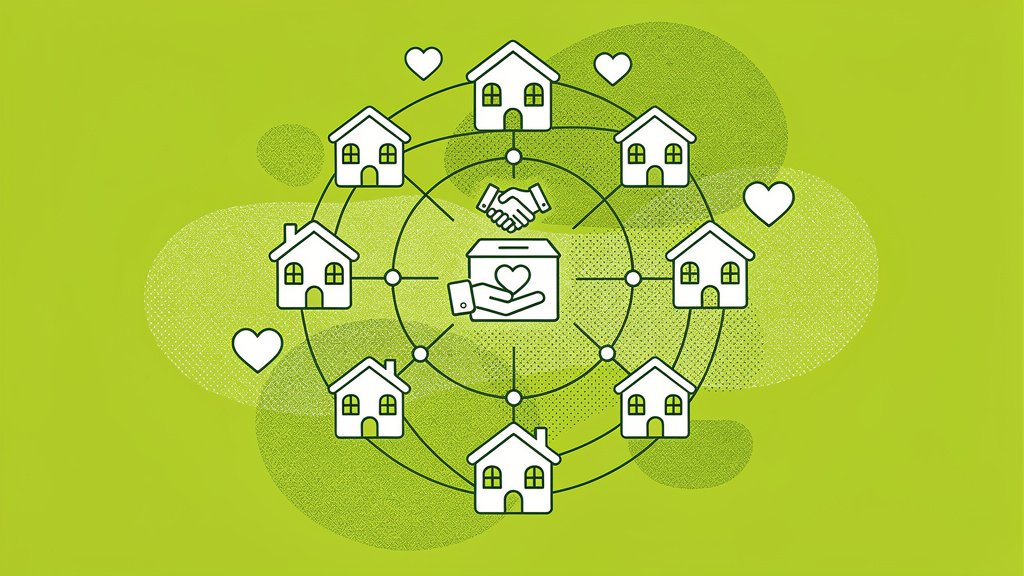
Nextdoor did something most social networks never bothered to try: it made the internet feel like your actual street. And honestly, there’s a lot nonprofits can learn from that approach, especially if you’re tired of sending the same generic appeal to thousands of people who barely remember signing up for your list. Hyper-local isn’t just a buzzword. It’s a fundamentally different way of thinking about who you’re talking to and why they should care.
In this piece, we’re going to dig into what makes Nextdoor’s model tick and, more importantly, how you can borrow its best ideas for your own community-based fundraising. We’ll cover geo-targeting, building donor trust, peer-to-peer campaigns with a local twist, and even a few unconventional plays worth trying.
The Nextdoor Model in a Nutshell
Nextdoor requires address verification before anyone can post. That single design choice creates something genuinely rare online: trust by default. Users share safety alerts, recommend plumbers, organize block parties, and increasingly, rally around local causes. Its features, including neighborhood feeds, events, polls, the Faves AI recommendation engine, and a peer marketplace, all orbit one core principle: relevance scales down, not up.
For nonprofits, the takeaway is clear. The tighter the geographic frame around your fundraising message, the more personal it feels, and the harder it is to ignore.
Geo-Targeting: Making Every Ask Feel Like a Neighbor Knocking
Nextdoor’s Sponsored Posts reach residents in precise areas, whether that’s a flood zone, a single ward, or a three-block radius. You don’t necessarily need Nextdoor’s ad platform to replicate this. Layering geo-filters into your email campaigns, using Facebook’s local targeting tools, or even sorting direct mail by zip code can get you surprisingly close.
The difference between “Help us fight hunger” and “Your gift feeds families on Elm Street” isn’t just a copywriting tweak. It’s a fundamentally different donor psychology. One is a cause. The other is a neighbor.
| Nextdoor Feature | Nonprofit Application | Expected Benefit |
|---|---|---|
| Address Verification | Donor zip-code matching in your CRM | Higher trust, stronger open rates |
| Neighborhood Feeds | Local impact stories segmented by area | Increased conversions through relevance |
| Sponsored Local Posts | Geo-fenced digital ads | Precise reach to high-intent local supporters (Nextdoor Business) |
Protip: Integrate your CRM data with a mapping tool like Google Maps API to auto-segment donors by proximity to your programs. Run a pilot in one neighborhood before scaling, and measure open rates and conversions separately from your general list. You want to actually see the “local lift” in the numbers before you go all-in.
Trust Through Verification and Radical Transparency
Nextdoor’s verification requirement isn’t just a spam filter. It’s the entire foundation of why people engage at all. When users know their neighbors are real, they behave differently. They recommend. They show up. They give.
90% of US neighbors on Nextdoor plan hyper-local giving like donations or volunteering around the holidays (AInvest.com). And that willingness doesn’t come from slick marketing. It comes from verified identity and visible community context.
Nonprofits can build this same trust loop by being radically transparent after a gift lands. Instead of a generic thank-you email, try neighborhood-specific updates: “Your $50 helped three families in Riverside get groceries this week.” When donors can see their money landing close to home, retention improves dramatically.
Peer Sharing and Marketplace Fundraising: The Sell for Good Model
One of Nextdoor’s more creative partnerships was Sell for Good with Feeding America. Neighbors could list items on the marketplace and donate proceeds directly. The campaign generated 113 million views and a 4.5% increase in marketplace posts (Nextdoor Business). GoFundMe ran a similar play, reaching 2 million neighbors through targeted Nextdoor campaigns (Nextdoor Business).
Three ways to adapt this for your nonprofit:
- Neighborhood Swap for Good. Invite supporters to sell unused items on Facebook Marketplace or your own site and donate proceeds through a tracked giving form.
- Peer-to-peer fundraisers tied to local events. A 5K in one zip code, a bake sale in another, each with its own fundraising page and its own neighborhood story.
- Virtual yard sales promoted through Nextdoor’s event tools, with all revenue directed to a specific local program.
Platforms like Funraise make this trackable at scale. Their peer-to-peer fundraisers raise 2x more than top industry programs (Funraise.org), and the free tier means you can test neighborhood-level P2P campaigns without betting your budget on it.
Try This Prompt in Your Favorite AI Tool
Copy and paste the prompt below into ChatGPT, Gemini, Claude, Perplexity, or whichever AI tool you use daily. It’s designed to help you sketch out a hyper-local fundraising campaign tailored to your organization.
Design a 30-day hyper-local fundraising campaign for [NONPROFIT NAME], a [NONPROFIT TYPE] serving [GEOGRAPHIC AREA]. The campaign should include three neighborhood-specific appeal messages, a peer-to-peer fundraising component, and one community event concept. For each element, suggest how to track results using an all-in-one fundraising software for nonprofits like Funraise.org, including donor segmentation by zip code, P2P page setup, and post-donation impact updates. Target donor persona: [DONOR DESCRIPTION].That said, there’s real value in using tools like Funraise that have AI components built directly into the platform where you’re already executing tasks. Full operational context beats copy-pasting between disconnected apps every time.
What We See Go Wrong (Before and After the Switch)
After working alongside nonprofit leaders for over a decade, a few patterns show up again and again. These are easy traps to fall into.
“We treated every donor the same.” A mid-size food bank was sending identical year-end appeals to 14,000 contacts across six counties, and response rates hovered around 1.2%. When they segmented by neighborhood and referenced local distribution sites, response rates tripled in two zip codes within a single campaign cycle.
“Our peer-to-peer pages were ghost towns.” A youth mentorship org launched P2P fundraising with zero geographic framing. No story hook, no local anchor. Once they restructured pages around specific school districts, each with neighborhood context and a local mentor’s story front and center, the average page raised 2.4x more.
“We had data but no way to act on it.” Multiple organizations had donor addresses sitting in spreadsheets, never once used for geo-targeting. Connecting that data to a platform like Funraise, which supports segmentation and automated workflows, turned dormant information into active strategy.
Events, Polls, and the Power of Asking Before Asking
47% of Nextdoor neighbors prioritize donating items or cash locally (AInvest.com). But here’s what’s worth noticing: Nextdoor doesn’t just broadcast at people. It asks them what they care about first, through polls, neighborhood input threads, and event RSVPs.
Nonprofits can borrow this directly. Before launching your next campaign, post a “Neighborhood Needs Poll” through your channels. Ask residents what local issues matter most to them, then fundraise specifically for the top-voted priority. When 80% of a street says they want after-school programs, your ask basically writes itself.
Protip: Use free geo-filters on Nextdoor or Eventbrite for hybrid events. Follow up with Funraise peer links, where users see 50% donation form conversion rates (Funraise.org). Half the people who land on the form actually complete it.
“The nonprofits that win aren’t the ones with the biggest megaphone. They’re the ones who know their community well enough to whisper the right message to the right person at the right time.”
Funraise CEO Justin Wheeler
An Unconventional Play: Secret Neighbor Funds
Borrow from Nextdoor’s privacy-first culture and add some gamification to your giving. Launch a “Secret Neighbor Fund” where anonymous local donors crowdfund a visible community improvement, like park benches, a mural, or school supplies for a specific classroom. Donors stay anonymous until the goal is hit, then a reveal event brings the block together.
It’s part fundraiser, part neighborhood block party, part feel-good moment people will actually talk about. Test it with Funraise’s P2P tools. Organizations like The Cupcake Girls have seen 386% revenue increases using similar creative peer-to-peer structures (Funraise.org), and this kind of approach can punch well above its weight.
Your 90-Day Roadmap
| Timeframe | Action | Success Metric |
|---|---|---|
| Week 1 | Claim your Nextdoor business or public agency page; post a community needs poll | Poll responses collected |
| Month 1 | Launch one geo-targeted P2P campaign inspired by Sell for Good | Number of peer fundraisers activated |
| Quarter 1 | Host 1-2 neighborhood events; track giving by zip code | 2x P2P fundraiser performance vs. previous campaigns |
Start with Funraise’s free tier to build your infrastructure. Organizations using the platform grow online revenue 73% year over year, which is 3x the industry benchmarks from M+R and Blackbaud (Funraise.org). You don’t need a massive budget to make this work. You just need a neighborhood that knows your name.
Nextdoor proved that hyper-local beats broadcast. And your nonprofit already has the most important ingredient in the mix: a community that genuinely cares about what happens on its own streets. Give them the tools, give them the story, and let them run with it.
About the Author

Companies that donate to schools: 40 programs and how to apply
Schools and nonprofits often picture corporate giving as one big, splashy check from a household name. Truth is, most of that support shows up in smaller, less glamorous forms: local grants, gift cards, employee matching, volunteer hours, customer-round-up programs. The real skill isn't finding companies with deep pockets. It's figuring out which giving mechanism actually…
25 youth sports fundraising ideas for leagues, teams and travel clubs
Let's be honest: youth sports fundraising usually starts the same way. Someone volunteers (or gets voluntold) to figure out how to cover uniforms, tournament fees, and that one kid whose family can't quite swing the travel costs this season. It's stressful, it's often disorganized, and it tends to fall on whoever raised their hand slowest…
30 PTA fundraising ideas that need no selling and no committee
Every PTA leader knows this feeling: another meeting, another spreadsheet tracking who's selling wrapping paper, another volunteer who's gone quiet on emails. Product sales and big events can raise money, sure, but they eat up people power that most schools just don't have lying around. Here's the good news: you don't need a sales table…