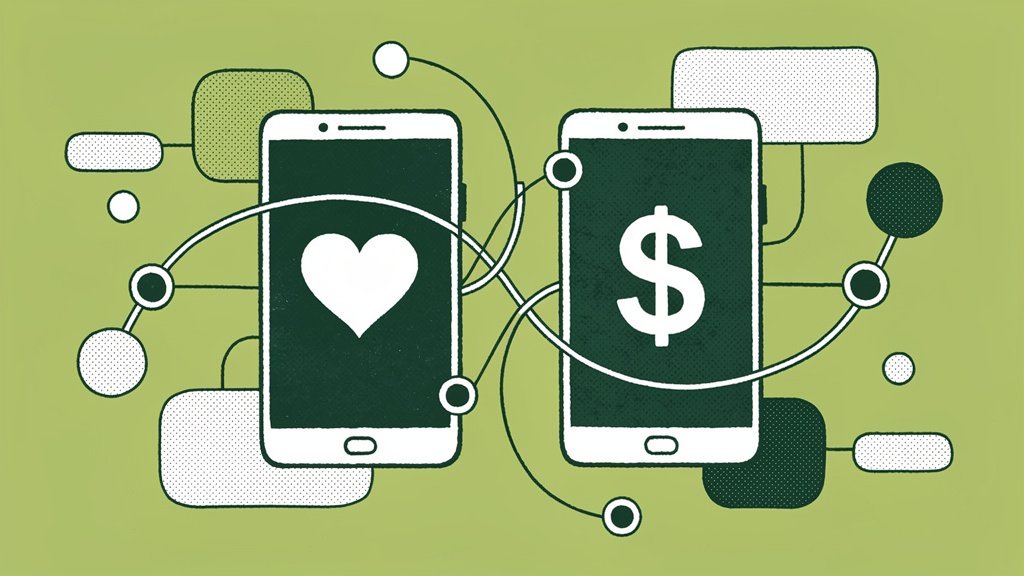
Choosing between text to give and text to donate feels like it should be simple, right? Two similar-sounding tools, pick one, move on with your day. But here’s the thing: the labels get used so loosely across platforms that the real decision isn’t about terminology at all. It’s about what actually happens after a donor taps “send” on their phone, and whether your small team can do anything useful with what comes next.
So that’s what we’re digging into here. We’ll break down the actual difference between these two mobile giving methods, why the choice matters so much more when you’re a one-person shop or an all-volunteer crew, and when (if ever) the traditional route still makes sense. Plus, we’ll hand you a ready-to-use AI prompt to map out your own campaign, and a scorecard for measuring whether it’s actually working.
The Difference in Plain English
Traditionally, text to give means a donor texts a keyword and authorizes a fixed amount that gets billed straight through their mobile carrier. Text to donate works a bit differently: the donor texts a keyword, gets a link back, and lands on a mobile donation form where they pick the amount and payment method themselves.
| Consideration | Traditional text to give | Text to donate |
|---|---|---|
| Donor action | Texts a keyword, confirms a preset amount | Texts a keyword, completes a form |
| Gift amount | Usually fixed | Donor’s choice |
| Payment route | Carrier billing | Online payment processor |
| Recurring giving | Limited or unavailable | Built into the form |
| Donor data | Often minimal | Name, email, preferences, consent |
| Branding | Limited | Fully customizable |
Why This Matters More for a Small Group
A national organization can shrug off thin donor data or a slow carrier payout, they’ve got the volume to absorb it. A community food pantry run by one part-time coordinator? Not so much. So the real question for a small group isn’t “which method moves fastest.” It’s “which method turns a one-time mobile gift into an actual relationship?”
Text to donate wins on that front in four ways:
- it makes donor stewardship possible, you can actually send a receipt and a thank-you,
- it lets donors direct their gift to a specific program,
- it opens the door to recurring revenue since monthly giving is one click away,
- it gives you reporting, every gift ties back to a campaign or keyword.
Protip: before picking a platform, jot down the minimum info you’d need to send a meaningful thank-you. For most small groups, that’s name, email, gift amount, campaign, and permission to follow up.
Familiar Struggles Before Switching
If any of this sounds familiar, you’re definitely not alone. We hear these same stories constantly from nonprofit leaders right before they switch to something better.
- the “who even gave this?” problem: a text campaign brings in real money, but the spreadsheet exported from the carrier has no names, no emails, nothing to work with when it’s time to say thanks,
- the disconnected-tools headache: texts come in through one vendor, donations land in another, and the CRM never syncs, so someone ends up burning a Friday afternoon manually reconciling gifts by hand,
- the one-and-done donor: someone gives once during an emergency appeal and then vanishes, simply because there was never a path to invite them into a recurring gift or a follow-up story.
None of these are rare edge cases, honestly. They’re the exact gaps that push small teams toward an all-in-one platform where texting, the donation form, and the donor record all live under one roof.
When Traditional Text to Give Still Makes Sense
Traditional text to give isn’t obsolete, to be clear. It genuinely shines when speed and mass participation are the priority, think emergency response, a live crowd, or a broadcast moment where a fixed, simple amount removes any friction.
And the scale it can hit is real: the American Red Cross raised $43 million through text-to-give during Haiti earthquake relief (Funraise). That’s an extraordinary emergency campaign though, not something to hold up as a typical benchmark for a neighborhood nonprofit.
The tradeoffs are just as real. Traditional programs often come with carrier fees, delayed fund access, thin donor records, and eligibility rules, Funraise notes some programs require a $500,000 annual fundraising minimum to even qualify (Funraise). That threshold alone rules out most small community groups before they even get started.
“The best mobile giving programs don’t just capture a gift, they capture the beginning of a relationship. If your text campaign can’t tell you who gave or why, you’ve won a transaction and lost a donor.”
Funraise CEO Justin Wheeler
Try This Prompt
Here’s a shortcut: copy the prompt below into your favorite AI assistant (ChatGPT, Claude, Gemini, or Perplexity all work fine) and let it map out a campaign for you in minutes.
I run a small nonprofit focused on [your cause or mission] in [your community or neighborhood]. Help me design a text-to-donate campaign with a keyword idea, a short SMS message under 160 characters, three donation amount suggestions tied to concrete impact, and a plan for following up with donors after the gift. My monthly fundraising goal for this campaign is [dollar amount], and I have [hours per week] available to manage it.Protip: once the AI hands you a campaign structure, you still need somewhere to actually run it, sync donor data, and track results without living in spreadsheets. An all-in-one fundraising platform like Funraise.org can take that AI-generated plan and turn it into a live mobile donation form connected to your donor records, so the strategy doesn’t just sit there in a chat window collecting dust.
In day-to-day fundraising work, we’ve found it helps to use tools that build AI directly into the platform you’re already using, rather than bouncing between a separate app, so you get full context without switching tabs every five minutes.
The Numbers Worth Watching
A successful text campaign isn’t measured by how many people texted a keyword, that’s just the top of the funnel. Track the whole path instead.
| Metric | What it tells you |
|---|---|
| Click-through rate | Whether the message drives people to the form |
| Form completion rate | Whether the page is easy on a phone |
| Monthly-gift conversion | Whether the campaign builds recurring revenue |
| Repeat-gift rate | Whether donors stick around |
Industry benchmarks help set realistic expectations here: mobile messaging generated 0.9% of nonprofits’ total online revenue in 2025, though mobile revenue grew 48% year over year, and for small nonprofits specifically, mobile averaged 3.1% of online revenue (M+R Benchmarks 2026). Average click-through landed at 3.7%, form completion at 4.2%, and response rate at 0.17% (M+R Benchmarks 2026). None of that means texting should replace your other channels, it just means texting is a strong conversion tool alongside email, events, and in-person asks.
Protip: build a simple scorecard before your first send, tracking audience size, keyword, total gifts, average gift, monthly-gift signups, and opt-outs. A $2,000 campaign that creates 40 real donor relationships often beats a $2,300 campaign that produces zero usable data.
The Practical Answer
For most small U.S. nonprofits, text to donate should be the default, provided your platform offers a mobile-friendly form, recurring giving, donor-record syncing, automated receipts, and reasonable fees. Save traditional text to give for genuine emergencies, the ones where speed outweighs everything else.
That said, the strongest approach usually blends both worlds:
- promote your keyword at events and on flyers,
- send a short personalized appeal,
- let the donation page tell a local story,
- offer monthly giving,
- follow up with a real result.
That’s really the whole point of text-to-donate for a small group, it turns a quick mobile gift into a lasting neighbor.
About the Author

Is Givebutter really free to use? What small nonprofits pay in practice and what alternatives are there
If you've spent any time poking around donation platforms, you've probably run into the claim that Givebutter is "100% free." It's a tempting pitch, especially when you're a small nonprofit watching every dollar leave the building. But here's the thing: the real answer has more layers to it than that headline suggests, and understanding those…
Top Bloomerang Alternatives for Small Community Nonprofits on a Tight Budget
The Bloomerang quote gave you pause. Here is the honest comparison for a small community nonprofit, including where the cheaper answer is the right one.

Best free donor management software for nonprofits (and when to upgrade)
Look, small nonprofits don't need the fanciest CRM on the market. What you actually need is somewhere to store donor records, log gifts, fire off thank-yous, and get the full picture of who's supporting you, without adding a line item your board has to sign off on. Good news: a handful of free donor management…