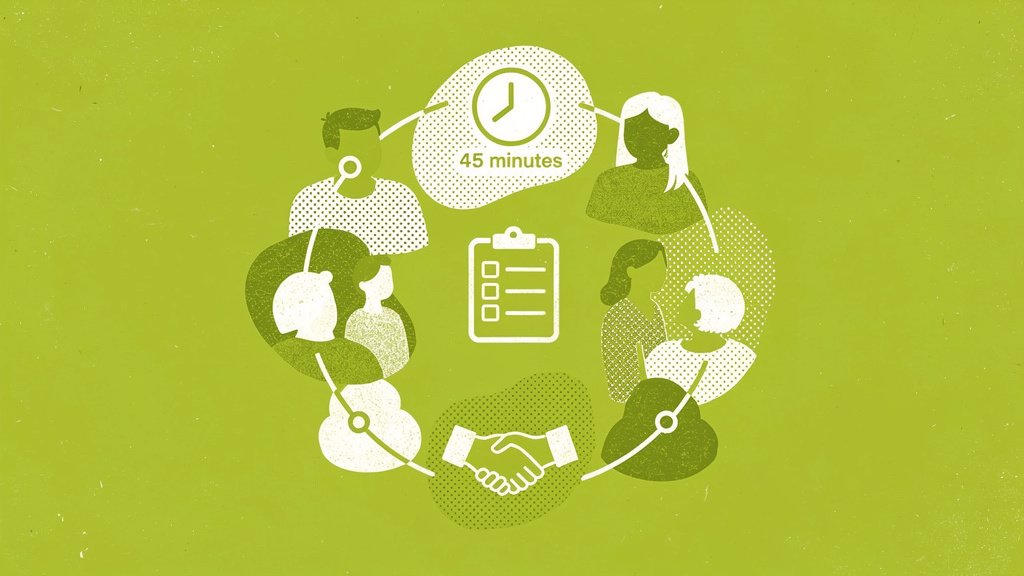
Volunteering is having a moment again. People are showing up, ready to help, and that’s genuinely exciting for community organizations that have spent years scraping together whatever hands they could find. But here’s the catch: those willing volunteers won’t stick around if their very first experience with your org feels chaotic or half-baked.
So what actually makes a volunteer orientation work? Turns out it’s not about covering everything you know about your organization in one sitting. It’s about making sure every person who walks through your door leaves knowing why the work matters, what they’re responsible for, how to stay safe, who to ask when they’re stuck, and what happens next. That’s it. Let’s dig into how to build that in about 45 minutes.
Orientation Is Not the Same as Training
Here’s a mistake we see a lot: mashing orientation and role-specific training into one marathon session. 501 Commons suggests keeping these separate, giving every volunteer the same general orientation and saving the task-specific stuff for its own moment. Splitting these two layers keeps your 45 minutes focused instead of turning into an info dump.
| Layer | Purpose | When it happens |
|---|---|---|
| Orientation | Mission, culture, safety, boundaries, logistics | Before the first shift |
| Role training | Specific tasks, tools, quality standards | During or just before the first shift |
| Ongoing support | Coaching, feedback, refreshers | Throughout the relationship |
Higher-risk roles, think anything involving kids, driving, food, or financial data, need extra screening and training on top of this. As a general rule, the riskier or more complex the work, the more prep it deserves.
Protip: build a “must know before the first shift” list and cap it at five items. Anything that doesn’t touch safety, role clarity, or the volunteer’s next step belongs in the handbook, not the orientation room.
The 45-Minute Agenda
Think of this as a template you can reuse every time. Assign someone to keep time, and end each segment with a quick check-in or interaction.
| Time | Segment | Outcome |
|---|---|---|
| 0:00-0:05 | Welcome and psychological safety | Volunteers feel expected |
| 0:05-0:12 | Mission and human impact | Volunteers connect their time to the mission |
| 0:12-0:20 | The volunteer role | Volunteers understand responsibilities and limits |
| 0:20-0:28 | Safety, privacy, conduct | Volunteers know how to protect themselves and others |
| 0:28-0:35 | Practical logistics | Volunteers know how the shift works |
| 0:35-0:41 | Meet the people and practice | Volunteers rehearse their first action |
| 0:41-0:45 | Readiness check and next step | Every volunteer leaves with a concrete action |
A couple of these segments deserve extra care. For mission and human impact, skip the formal mission statement (nobody remembers those anyway) and just answer four plain-language questions: what’s happening in the community, who’s affected, what your nonprofit actually does, and how this specific role fits in. One short, consent-appropriate story will land better than any slide deck.
For the volunteer role, be upfront about what people should not do. Boundaries protect everyone involved. That could mean no promising services, no unsolicited advice, no handling cash, no discussing a participant’s situation outside the room. Funraise’s volunteer-management guidance points to this as one of the most overlooked steps in the whole process: setting clear expectations around hours, performance, and quality from the jump.
Where Small Nonprofits Actually Struggle
If any of this sounds familiar, you’re definitely not alone. These are the patterns we hear about constantly from nonprofit leaders, usually right before (or while) they’re trying to fix their volunteer process:
- the “we’ll be in touch” ending, where orientation wraps, everyone nods and smiles, and then nobody actually books a first shift. A few weeks later, that volunteer has quietly vanished,
- paperwork chaos, where volunteers show up without their background checks or waivers done, and suddenly half your meeting is an administrative scramble instead of a warm welcome,
- the information dump, where a well-meaning coordinator tries to squeeze in the org’s entire history, every policy, and every task in one go, leaving volunteers more overwhelmed than confident.
Catching these patterns early is often what finally pushes an org to formalize its orientation instead of winging it every single time.
Protip: never let orientation end without a booked first shift already on the calendar. “We’ll be in touch” isn’t a next step. “Your shift is Saturday at 9 a.m., and Maria will meet you at the side entrance” is.
A Prompt You Can Use Today
Want to turn this agenda into something built specifically for your org, in minutes? Copy the prompt below into whatever AI tool you’re already using, ChatGPT, Claude, Gemini, Perplexity, doesn’t matter, and fill in the brackets.
Act as a volunteer program coordinator for a small nonprofit. Build a 45-minute volunteer orientation script for our organization, [nonprofit name], focused on our mission of [mission or cause]. Our volunteer role is [role description], and our biggest risk area is [safety or compliance concern]. Include a welcome, a two-minute impact story, role boundaries, a safety scenario, logistics, and a readiness check with three closing questions.Once your script is ready, the real work starts: making sure volunteer data, hours, and follow-up messages don’t fall through the cracks after everyone leaves the room. That’s where all-in-one fundraising software like Funraise.org comes in handy, not as some fancy extra, but as something genuinely practical. It can track sign-ups, automate that all-important 24-hour thank-you note, and keep supervisor notes in one spot instead of scattered across five spreadsheets. And since Funraise has a free tier, you can poke around and see if it fits your workflow before committing to anything.
“The nonprofits that retain volunteers longest aren’t the ones with the flashiest orientation deck. They’re the ones who treat the first 45 minutes as the start of a relationship, not a compliance checkbox.”
Funraise CEO Justin Wheeler
Small Design Choices That Make It Stick
A short orientation works because of decisions made before the meeting, not during it.
- a one-page role card that gives each volunteer the role name, shift time, supervisor contact, three to five core tasks, boundaries, and their next scheduled shift, beating a thick handbook on day one,
- a pre-orientation message sent a day or two out with logistics, what to bring, and any forms they can knock out in advance, keeping your 45 minutes from turning into a paperwork appointment,
- a “parking lot” for off-topic questions, a running list for anything that doesn’t need answering right now, with an owner and a follow-up date assigned so you can move on,
- a buddy system that pairs new folks with experienced volunteers for the first shift or two, doing more for first-day nerves than any slide ever could.
Hybrid options matter here too. AmeriCorps reports that 82% of formal volunteers served entirely in person in 2023, while more than 13.4 million people took part in virtual or hybrid volunteering (AmeriCorps). Offering a hybrid orientation can open the door for people juggling transportation, caregiving, or disability-related constraints, as long as in-person practice is still available for roles that genuinely need it.
Protip: if your group’s bigger than eight or ten people, skip the full round-robin introductions. Have people share names in pairs first, then invite two or three observations to the whole room. Saves five minutes, keeps the human connection.
Turning Attendance Into Engagement
Orientation is the starting line, not the finish. Within 24 hours, send a thank-you, the role card, and shift confirmation. After the first shift, ask three quick questions: what felt clear, what was confusing, what would make next time better. Around day 30, check attendance and invite them to grab another shift.
Worth tracking over time:
- orientation attendance,
- first-shift attendance rate,
- time between orientation and first shift,
- and 30-day return rate.
These numbers won’t replace real relationships, but they will show you exactly where volunteers are slipping away, whether that’s scheduling friction, fuzzy expectations, or just a rough first day.
In day-to-day nonprofit work, it helps to lean on tools built for this reality. Solutions like Funraise come with AI components built directly into the workflow, so coordinators get full operational context without switching between five different tools.
About the Author


Companies that donate to schools: 40 programs and how to apply
Schools and nonprofits often picture corporate giving as one big, splashy check from a household name. Truth is, most of that support shows up in smaller, less glamorous forms: local grants, gift cards, employee matching, volunteer hours, customer-round-up programs. The real skill isn't finding companies with deep pockets. It's figuring out which giving mechanism actually…
25 youth sports fundraising ideas for leagues, teams and travel clubs
Let's be honest: youth sports fundraising usually starts the same way. Someone volunteers (or gets voluntold) to figure out how to cover uniforms, tournament fees, and that one kid whose family can't quite swing the travel costs this season. It's stressful, it's often disorganized, and it tends to fall on whoever raised their hand slowest…

30 PTA fundraising ideas that need no selling and no committee
Every PTA leader knows this feeling: another meeting, another spreadsheet tracking who's selling wrapping paper, another volunteer who's gone quiet on emails. Product sales and big events can raise money, sure, but they eat up people power that most schools just don't have lying around. Here's the good news: you don't need a sales table…